
Choosing a Recovery Partner: An Evaluation Framework for Decision Makers

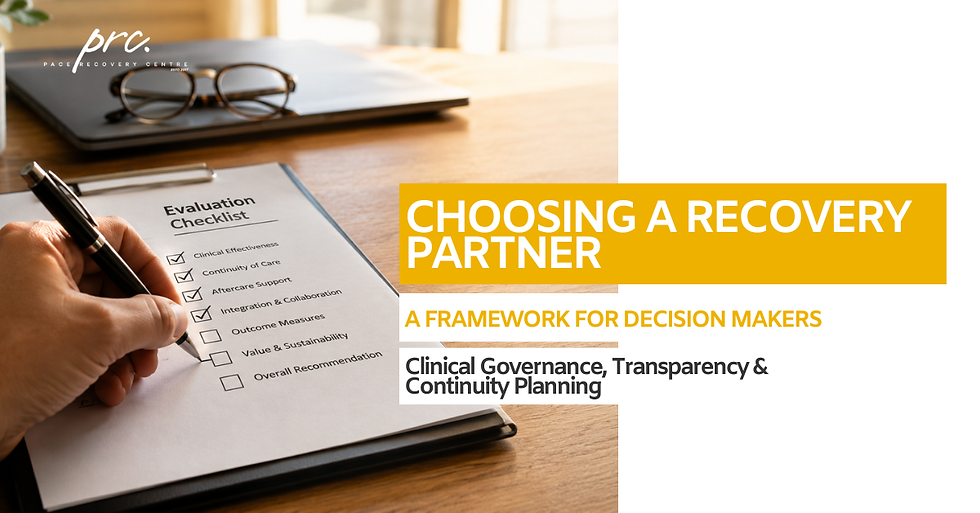
Funders deciding where to direct support. Employers deciding which facility to trust with a struggling employee. Healthcare professionals and EAP providers deciding who to refer a client to. Each of these decisions carries real consequences, and each is frequently made on incomplete information.
Most evaluation of a recovery partner happens on criteria that are visible but not necessarily meaningful: how a facility presents itself, how long a programme runs, how polished its marketing materials appear. These factors are not irrelevant, but they are incomplete on their own. None of them, in isolation, indicate whether a facility can consistently deliver the outcomes a decision maker is relying on.
This article sets out a more practical approach: four operational criteria that decision makers can use to evaluate a recovery partner, along with the specific questions that bring those criteria to life.
Why Evaluation Usually Happens on the Wrong Criteria
Decision makers are rarely clinicians. A funder, an HR manager, or a referring GP cannot easily assess the clinical quality of a treatment programme directly. In the absence of clinical expertise, evaluation defaults to what is easiest to observe — facility appearance, length of stay, price point, and marketing language.
These proxies are not without value, but they are weak predictors of outcome. A well-presented facility with a polished website does not necessarily have strong clinical governance behind it. A longer programme does not automatically mean better-coordinated discharge planning is in place.
The criteria that actually predict whether a recovery partnership succeeds tend to be operational rather than visual, and they are rarely the first things a decision maker is shown.
This is not a criticism of decision makers themselves. It reflects a genuine information gap between what facilities present and what would actually allow an informed comparison between providers.
The Four Pillars of Recovery Partner Evaluation
Decision makers evaluating a recovery partner are better served by examining four specific operational pillars, rather than forming a general impression:
Clinical governance. Is treatment overseen by qualified, accountable clinical leadership? Are protocols documented, consistent, and subject to regular review, rather than dependent on any single individual?
Integration capability. Can the facility coordinate effectively with referral partners, families, employers, and aftercare providers, both during treatment and after discharge?
Transparency. Does the facility provide clear, honest information about outcomes, costs, and limitations, or does it rely primarily on curated success stories?
Continuity planning. Is discharge and aftercare planning built into the treatment process from the outset, or treated as an administrative step once treatment concludes?
A facility may perform well on one pillar and poorly on another, and decision makers benefit from assessing all four rather than assuming strength in one area implies strength across the others.
Strong clinical governance without integration capability can still produce fragmented outcomes once a client leaves residential care. Effective integration without transparency can result in partnerships built on incomplete or overly optimistic information. All four pillars generally need to be present, and functioning together, for a partnership to hold up under real conditions over time.
"A confident, detailed response signals operational maturity. A vague or defensive response is itself useful information."
Questions Decision Makers Should Ask
Evaluation becomes considerably more practical when it is structured around direct questions, rather than general impressions formed during a single conversation or site visit. Useful questions include:
Who is clinically accountable for treatment decisions, and what does their oversight structure actually look like in practice?
How does the facility communicate with referral partners, both during treatment and in the period immediately following discharge?
What information is the facility willing to share about typical outcomes, including its limitations and the populations it is less suited to treat?
At what point in the treatment process does discharge and aftercare planning begin?
The value of these questions lies not only in the answers themselves, but in how willingly and specifically a facility engages with them. A confident, detailed response generally signals operational maturity and a facility that has already had to think through these questions internally.
A vague, deflective, or overly reassuring response is itself a meaningful data point, regardless of how the rest of the conversation goes.
The Gap Between Marketing Claims and Operational Reality
Every facility describes itself favourably. This is expected, and is not, on its own, a reason for concern. The more relevant distinction is whether marketing claims can be substantiated when tested against the four pillars described above.
A claim of individualized treatment should be verifiable through documented clinical governance structures, not only through testimonials describing a positive experience.
A claim of comprehensive aftercare should be verifiable through specific continuity planning practices, including who is responsible for follow-up and over what period.
A claim of being a trusted referral partner should be verifiable through how the facility actually communicates with other providers in practice, rather than through general statements about partnership.
Decision makers who take the time to test claims against these operational pillars, rather than accepting them as presented, tend to make more reliable choices over time — regardless of which specific facility they ultimately select.
Conclusion: Applying Recovery in Practice Means Choosing Well
Understanding why provider coordination matters, why funding structures shape outcomes, and why workplace risk requires structured response, is necessary groundwork. On its own, however, that understanding is not sufficient. At some point, every decision maker has to choose a specific partner, and that choice ultimately determines whether everything understood in principle actually translates into practice.
For decision makers, applying recovery in practice begins with evaluating potential partners against the criteria that genuinely predict whether a partnership will hold over time: clinical governance, integration capability, transparency, and continuity planning.
Asking direct questions, and testing marketing claims against operational reality rather than impression alone, is what allows understanding to become a sound, defensible decision.


Comments