
Recovery Partner Implementation: What Happens After the Decision Is Made


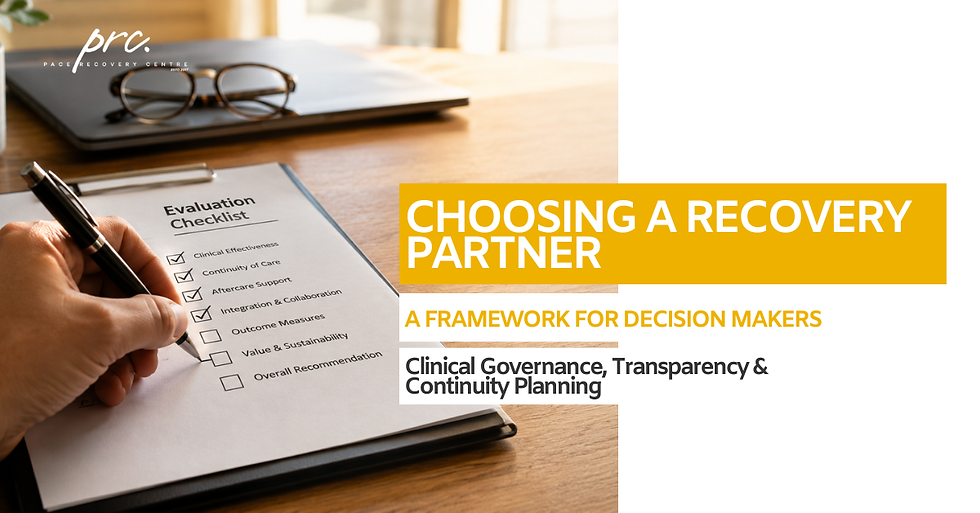
Last month, we looked at how organizations — funders, employers, referral providers — should evaluate a recovery partner before committing to one. Governance, integration, transparency, continuity: four pillars worth testing before any agreement is signed. Read the full evaluation framework here.
That evaluation matters, but it answers a narrower question than it sometimes appears to. It tells you whether a facility is capable of a good partnership. It doesn't tell you whether that partnership will actually run well once implementation is underway.
This month, we're turning to that second question. Not how to choose well, but what recovery partner implementation actually looks like once the choice has been made — and what organizations should reasonably expect to see, and ask about, along the way.
Why implementation deserves its own scrutiny
A facility can perform strongly on every evaluation criterion and still fall short operationally, months into an active partnership. This isn't usually because the original evaluation was wrong.
It's because implementation is a different kind of test — ongoing, unscripted, and harder to observe from the outside than a pre-admission conversation.
An organization that referred a client, funded a placement, or built a partnership around a facility's stated capabilities has a legitimate, ongoing interest in what happens next. Four areas are worth watching in particular, and each one is a place where operational reality either matches what was promised, or quietly drifts from it.
Onboarding and the handoff
The period between a decision being made and a client actually beginning treatment is where a lot of early friction shows up. Who confirms admission details. Who communicates timelines to the referring party. Whether the handoff from initial assessment to the treating team is documented, or left to informal conversation between whoever happened to take the call.
None of this is glamorous, and none of it shows up in marketing material. It's also where an organization gets its first real signal about whether a facility's internal coordination matches what was described during evaluation.
A smooth admission process, communicated clearly to everyone involved, is a strong early indicator.
A confused or delayed one, even for reasons that are individually forgivable, is worth noting rather than dismissing.
Communication cadence once treatment is underway
A facility can promise regular updates during the evaluation stage and then default to silence once a client is admitted and the immediate pressure to make a good impression has passed. This is one of the more common gaps organizations report after the fact — not a single dramatic failure, but a slow drop-off in contact once attention moves elsewhere.
This matters differently depending on who the organization is. An employer managing a staff member's leave and eventual return to work needs a different kind of update than a funder tracking outcomes across a caseload, and both need something different from a referring provider maintaining their own continuity of care.
A well-run recovery partner implementation should account for this — different stakeholders, different information needs, a communication plan that reflects both.
Worth asking early and directly: who initiates contact during treatment, on what schedule, and what specifically triggers an update outside that schedule. Vague answers here tend to become vague practice later.
What happens when a plan needs to change
Treatment plans shift. A client's needs at week one are rarely identical to week six, and a facility that presents its original plan as fixed is arguably overstating its own certainty.
The relevant operational question isn't whether change happens — it will — but who is responsible for identifying it, and how that change gets communicated to the organization that referred or is funding the placement.
A facility with strong internal governance should be able to describe this process concretely: who reviews a plan and how often, what triggers escalation, and what a referring organization can expect to be told, and when, if something shifts significantly.
If the honest answer is that changes happen and organizations simply aren't informed unless they ask, that's a meaningful gap in implementation, whatever the original evaluation suggested.
Discharge and what comes after
Continuity planning was one of the four evaluation pillars last month. Implementation is where that planning either gets executed or doesn't. A discharge plan that existed on paper during evaluation needs to translate into an actual handoff — to family, to an employer's return-to-work process, to a referring provider's own follow-up structure.
This is often the point where an organization's involvement is assumed to end, sometimes by the organization itself. It's also where a client is most at risk, and where a partner's operational maturity is most visible.
A facility that treats discharge as a clean end point, rather than a transition that needs active coordination, is likely to under-deliver here regardless of how strong its clinical work was up to that point.
Why this matters for organizations specifically
None of these four areas — onboarding, communication, plan changes, discharge — are things a client experiences in isolation. Each one involves an organization on the other end of the relationship: a funder tracking outcomes, an employer managing a return to work, a provider maintaining continuity of care.
Recovery partner implementation isn't only a clinical matter. It's an operational one, and organizations have a legitimate, ongoing stake in understanding how it actually works, not just how it was described before a decision was made.



Comments